
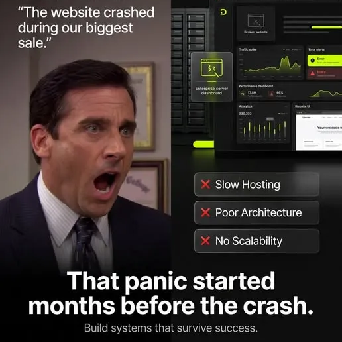
Is Your Website Ready for Your Biggest Traffic Spike?
The worst time to discover your website has a problem is when your customers do.
A sudden traffic spike can be exciting for any business. Maybe your marketing campaign goes viral, a product becomes popular, or your biggest sale brings thousands of visitors to your website.
But there is one problem: Can your website handle it?
A website that works perfectly under normal traffic can suddenly become slow, unstable, or completely unavailable when demand increases. And when that happens, you aren’t just dealing with a technical issue you could be losing customers, sales, trust, and valuable business opportunities.
Why Do Websites Fail During Traffic Spikes?
Most website failures don’t happen overnight. They are often the result of problems that were ignored during development or never addressed as the business grew.
Here are some of the most common warning signs.
1. Slow Hosting and Server Performance
Your hosting environment plays an important role in how quickly and reliably your website responds to visitors.
If your server has limited resources or isn’t configured for your website’s traffic requirements, performance can deteriorate when visitor numbers increase.
A website performance optimization strategy should consider hosting capacity, server response times, caching, database performance, and the overall infrastructure supporting your website.
2. Weak Website Architecture
A website can look impressive on the surface while having an inefficient technical foundation underneath.
Poorly structured code, unnecessary scripts, inefficient database queries, and an architecture that wasn’t designed with future growth in mind can create serious performance problems.
Professional website development services should focus on more than simply getting a website online. The underlying architecture should be organized, maintainable, secure, and capable of supporting future improvements.
3. Poor Scalability
Your website shouldn’t only be designed for the number of visitors you have today.
What happens when your business grows 2x, 5x, or even 10x?
Scalability should be considered from the beginning. A properly planned website can be upgraded and expanded without requiring an expensive rebuild every time your business experiences growth.
This is one reason businesses should carefully evaluate a website development agency before starting a major project.
4. Poor Mobile Performance
A reliable website also needs to perform well across different devices.
Customers may discover your business through smartphones, tablets, laptops, or desktop computers. If your website loads slowly or becomes difficult to use on smaller screens, visitors may leave before completing an important action.
Working with a professional responsive website development company can help ensure that your website delivers a consistent experience across different screen sizes.
Website Performance Is More Than Loading Speed
When people hear “website performance,” they often think only about how quickly a page loads.
Performance is much broader than that.
A reliable website should be able to:
- Handle increased traffic
- Respond quickly to user interactions
- Maintain stable performance during busy periods
- Work efficiently across different devices
- Process requests without unnecessary delays
- Scale as the business grows
- Recover effectively from unexpected problems
This is why website performance optimization should be treated as an ongoing part of your digital strategy rather than a one-time technical task.
Build for Growth, Not Just Launch Day
Launching a website is only the beginning.
The real test comes when your business starts attracting more customers.
A professional website development firm should consider future traffic, functionality, integrations, security, performance, and scalability during the development process not after your website starts failing.
Whether you’re launching a new website or improving an existing one, your technology should support your ambitions instead of becoming a limitation.
What Should You Upgrade First?
If your website is already experiencing performance problems, start by identifying the biggest bottleneck.
Review your:
- Hosting and server resources
- Website architecture
- Database performance
- Images and media
- Third-party scripts
- Caching configuration
- Mobile performance
- Security and monitoring
- Traffic-handling capacity
- Overall scalability
A professional performance audit can help identify which improvements will have the greatest impact.
Your Website Should Be Ready for Success
The goal of a successful website isn’t simply to survive launch day.
It should be ready for your biggest sale, largest campaign, sudden traffic spike, and next stage of growth.
Investing in quality web development services and continuous website performance optimization can help turn your website from a potential business bottleneck into a reliable foundation for growth.
At Devstank, we help businesses build and improve websites with performance, scalability, user experience, and long-term growth in mind.
Don’t wait for your customers to discover your website’s problems first. Build it to handle success from the start.
Visit Devstank to explore professional website development and digital solutions for growing businesses.